Skip to content
  • Same-day service
  • Financing available
Spring Hill, FL (352) 555-0130
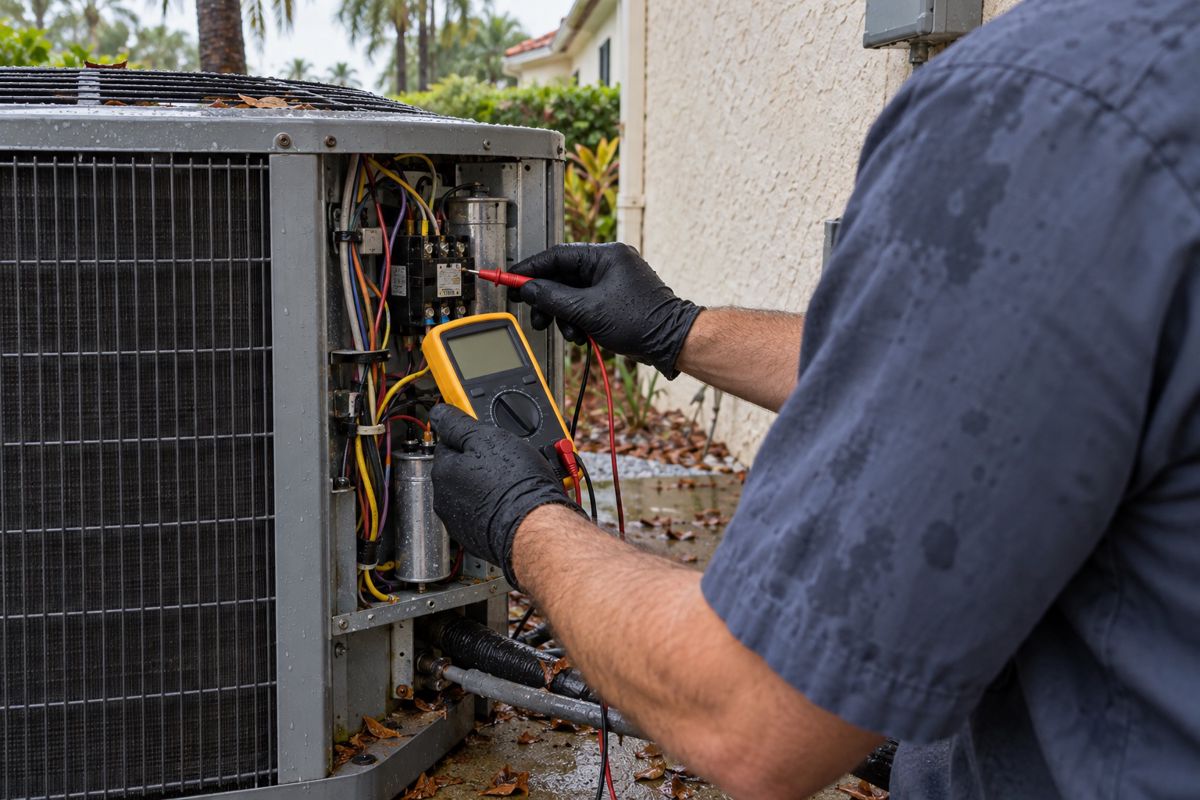
Technician's hands testing wiring inside an open outdoor AC condenser panel

AC repair in Spring Hill, FL

AC repair in Spring Hill when your house stops cooling

We diagnose central air conditioners and heat pumps and explain the fix in plain words. You see the written quote before any repair starts.

  • Central air conditioners and heat pumps
  • Written quote before repair work begins
  • Clear explanation of what failed and why

What does AC repair in Spring Hill involve?

AC repair in Spring Hill starts with finding out why the system is not doing its job. A technician listens to your description, checks the thermostat and then works through the indoor and outdoor equipment. They look at airflow, electrical parts, refrigerant pressures, the condensate drain and the controls.

The aim is a clear answer to three questions. What failed? Is it sensible to repair? What happens if you wait? You should hear the answers in plain words, not a list of part names you cannot judge.

Repairs cover central air conditioners and heat pumps, including the outdoor condenser, the indoor air handler or coil, blower motors, capacitors, contactors, thermostats and drain lines. If a part is not worth repairing, you should be told so. Sometimes the honest advice is to compare a repair with a replacement before spending more money on an old system.

Why does my AC stop cooling in a Florida summer?

Air conditioners in Spring Hill work hard for much of the year. Long run times and humid air bring a familiar set of problems.

  • Frozen evaporator coil. Often caused by a dirty filter, weak airflow or low refrigerant. Ice on the indoor coil blocks air, and the house warms up.
  • Clogged condensate drain. Humidity produces a lot of water. Algae can plug the drain line, and many systems shut off or leak when it backs up.
  • Failed capacitor or contactor. These small electrical parts wear out in the heat and are a common reason the outdoor fan or compressor will not start.
  • Refrigerant leak. Low refrigerant means weak cooling. Adding more without finding the leak only delays the next failure.
  • Storm damage. Summer thunderstorms bring lightning and power surges that can damage the control board, compressor or thermostat.
  • Coastal wear. Homes closer to the Gulf, such as near Hernando Beach and Weeki Wachee, may see outdoor coils wear faster because of salt in the air.

Many of these cost less to fix when caught early. Warm air from the vents, ice on the pipes, water near the air handler and a unit that clicks but will not start are all worth a call.

What changes the cost of an AC repair?

We do not post prices here because every repair is different. The number usually depends on the following.

  • Which part failed, and whether it is a small part such as a capacitor or a large one such as a compressor or coil.
  • The age and brand of the system, which affects whether parts are easy to find.
  • The type of refrigerant. Older systems use a refrigerant that costs more to service than newer types.
  • Access. A unit in a tight attic takes longer to work on than one in a garage or on the ground.
  • Whether a second problem sits behind the first, such as a failing motor that damaged another part.

Ask for the repair price in writing, with parts and labor described, before you approve the work. A quote you can read at the kitchen counter is better than a verbal number given on the roof. If the repair is large and the system is old, ask for the cost of replacement next to it so you can compare the two.

Many repairs are finished in a single visit, especially when the part is common. Some need a part ordered, which adds time. A refrigerant leak search or a failed compressor takes longer than swapping a capacitor. We cannot promise a time before someone has looked at the system, and anyone who does should be questioned.

On the day, expect this.

  1. The technician asks what you have noticed and when it started.
  2. They check the thermostat, filter, drain and the indoor unit.
  3. They test the outdoor unit and its electrical parts.
  4. They explain what they found and give you the options and the price.
  5. If you approve, they repair the system, test it and show you the result.

Clear a path to the air handler and the outdoor unit before the visit. Keep pets away from the work area. Tell the technician about any recent storm, power outage or tripped breaker, since that history often points to the cause.

When should I call, and when is replacement the better choice?

Call as soon as you notice weak cooling, odd smells, water around the air handler, repeated breaker trips or a unit that runs all day without reaching the set temperature. If you see ice or water, switch the system off so the problem does not grow. Hot weather is hard on older adults, young children and anyone with health problems, so plan a cooler place to stay if the repair will take time.

If your system is roughly ten to fifteen years old or more, has been repaired several times or has a failed compressor, ask about replacement. Our page on AC installation in Spring Hill explains how that works, and HVAC maintenance covers how to keep the next system out of trouble. You can also start from the home page to see everything Spring Hill HVAC covers.

How it works

  1. Book a visit

    Call or request a time online.

  2. Diagnosis and quote

    A technician finds the problem and quotes the fix.

  3. Repaired or replaced

    Most repairs finished the same day.

  • Same-day service
  • Financing available
  • Clear communication
  • Upfront pricing

Request ac repair

Tell us what you need and we call you back.

Step 1 of 3

What do you need?

No obligation.

Questions about hvac in Spring Hill

Why is my AC running but blowing warm air?

Common causes include a frozen coil, a failed outdoor fan or compressor, a dirty filter, low refrigerant or a tripped breaker on the outdoor unit. Check that the thermostat is set to cool and that the filter is clean. If the air stays warm, turn the system off and call, since running it can make some problems worse.

Is it safe to keep running an AC that is freezing up?

It is better not to. Ice on the indoor coil blocks airflow, and running the system can send liquid refrigerant to the compressor, which is an expensive part. Switch the system to fan only to melt the ice, or turn it off, and call for a diagnosis. Do not chip the ice off.

Do you repair heat pumps as well as air conditioners?

Yes. Heat pumps use the same basic equipment as a central air conditioner and are very common in Florida homes. Repairs can cover the outdoor unit, the air handler, the controls and the heating mode. Tell us whether you have an air conditioner or a heat pump when you call so we can plan the visit.

Can a lightning strike or power surge damage my AC?

Yes. Control boards, capacitors, compressors and thermostats can all be damaged by surges. If your system stops working after a storm, check the breakers once and then call instead of resetting repeatedly. A surge protector made for HVAC equipment may help reduce the risk, and a technician can advise on options.

Is there anything I can check before I call?

Yes. Confirm the thermostat is set to cool and has working batteries if it uses them. Check the filter and replace it if it is clogged. Look at the breaker panel for a tripped switch. Make sure the outdoor unit is free of leaves and debris. If none of this helps, call and describe what you found.

Ready when you are

Call now or request a quote online.

(352) 555-0130